Benchmarks
Zeus compiles to native code through LLVM, so a fair question is: how fast is it today? This page tracks Zeus against Go (an optimized native compiler) and Node.js (a mature JIT) on a small set of basic, CPU-bound algorithms.
Measured 2026-07-11T09:57:48Z on Apple M1 Pro, Darwin 26.5.2 (arm64). Go go1.26.3 darwin/arm64, Node v22.22.2, hyperfine 1.20.0. Zeus v0.0.21-alpha-28-gfc5c343.
Summary
Wall-clock time per run — lower is better. Zeus vs Go / Zeus vs Node are Zeus’s time divided by the other language’s: below 1× means Zeus is faster, above 1× means slower.
| Benchmark | Zeus | Go | Node.js | Zeus vs Go | Zeus vs Node |
|---|---|---|---|---|---|
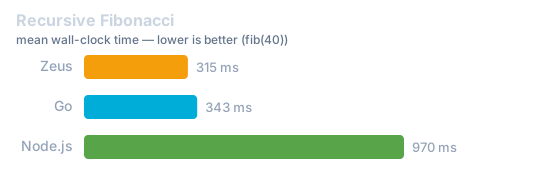
| Recursive Fibonacci | 315 ± 12 ms | 343 ± 2 ms | 970 ± 25 ms | 0.92× | 0.32× |
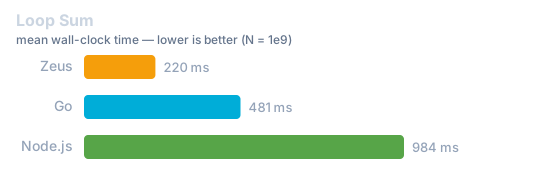
| Loop Sum | 220 ± 2 ms | 481 ± 12 ms | 984 ± 17 ms | 0.46× | 0.22× |
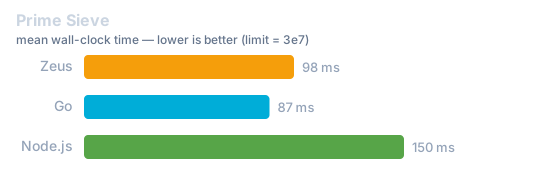
| Prime Sieve | 98 ± 3 ms | 87 ± 7 ms | 150 ± 2 ms | 1.13× | 0.66× |
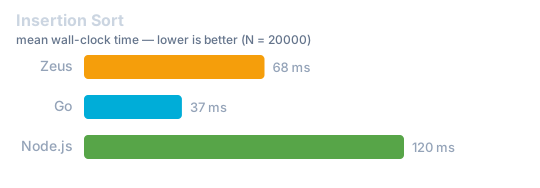
| Insertion Sort | 68 ± 1 ms | 37 ± 2 ms | 120 ± 15 ms | 1.84× | 0.56× |
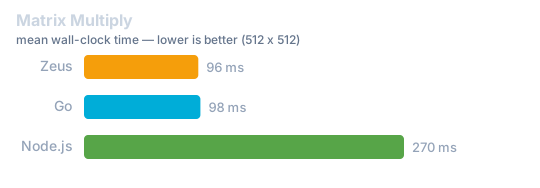
| Matrix Multiply | 96 ± 8 ms | 98 ± 3 ms | 270 ± 1 ms | 0.98× | 0.36× |
Results by benchmark
Recursive Fibonacci
Naive recursive fib(40). Dominated by function-call overhead and integer addition.
Loop Sum
Tight loop summing (i & 1023) over 1..1e9 in a 64-bit accumulator. Measures raw loop and integer-ALU throughput.
Prime Sieve
Sieve of Eratosthenes up to 30,000,000. Exercises large array allocation, indexing and nested loops.
Insertion Sort
O(n^2) insertion sort of a 20,000-element LCG-filled array. Exercises array get/set and comparisons.
Matrix Multiply
Naive 512x512 integer matrix multiplication. Exercises 2D arrays and a memory-bound triple-nested loop.